Most parts that come in as laser jobs could have been plasma cut for less money. A fair number of plasma quotes should have gone to laser. The processes overlap considerably in the middle of the thickness range, and that overlap is where most of the wrong calls happen.
Thickness and material are the primary decision variables. Edge quality requirements and feature geometry narrow it down from there. Once you know where your part falls on those axes, the answer is usually not difficult.
How each process cuts
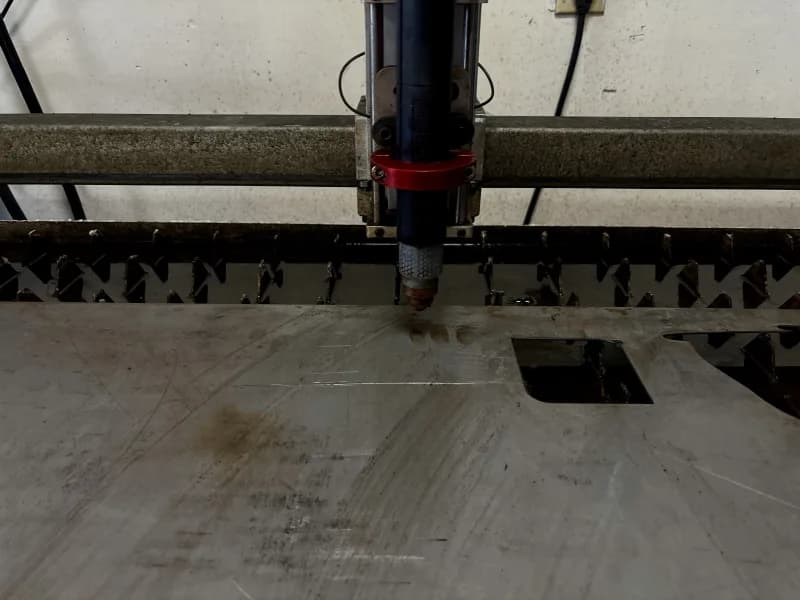
Plasma uses an electrical arc forced through a gas column by a constrictor nozzle, ionizing the gas into a plasma jet at temperatures that melt through conductive metal. High-velocity gas clears molten material from the kerf. It is fast on thick material, it produces a wider heat affected zone along the cut edge than laser does, and it requires an electrically conductive workpiece.
Laser uses a focused beam to melt or vaporize material along the cut path, with assist gas clearing the melt. The beam diameter is much smaller than a plasma arc, so the kerf is narrower and the heat affected zone is smaller. Fiber laser has largely replaced CO2 laser for sheet metal work over the last decade. It is faster, more energy efficient, and handles reflective metals that CO2 typically cannot.
Where plasma fits
Mild steel from about 3/16" to around 1" is plasma's natural territory. Below that thickness, the heat input becomes harder to control and warping becomes more likely. Above about 1.5", plasma can still cut, but bevel on the cut edge becomes more pronounced and edge quality degrades.
Plasma is cheaper to run per linear inch on thick material, and a CNC plasma table can move through structural shapes and plate quickly. If the part is a profile in 3/8" A36 with a few holes and the tolerance requirement is somewhere around +/-1/16" or looser, plasma is probably the right answer. It will be faster and cheaper than laser, and the edge quality is adequate for most structural or welded applications.
Stainless is manageable on plasma, though the cut edge tends to be rougher than on mild steel and the heat affected zone can cause hardening that creates problems in secondary operations like tapping. Aluminum cuts on plasma but takes more attention to gas selection and parameters.
Where laser fits
Thin material is where fiber laser has no real competition. From sheet gauge down to about 3/16" mild steel, laser is faster and produces a better edge than plasma at every point in that range. The kerf is tighter, the edge is cleaner, and hole locations are more consistent.
Tight tolerances favor laser. A CNC plasma table on 14-gauge mild steel under good conditions might hold +/-0.030" to +/-0.060" on feature location. A fiber laser on the same material can hold +/-0.005" to +/-0.010" routinely. That gap matters when a part has a hole pattern that has to line up with a mating component.
Fine feature geometry also favors laser. Small holes, tight internal radii, closely spaced slots: a plasma arc is physically wider than a laser beam, which limits the minimum feature size the process can produce reliably. A 1/8" diameter hole in 14-gauge steel is straightforward on laser. On plasma, it is not. As a rough guide, plasma's minimum reliable internal feature size is roughly twice the material thickness. Laser can usually match or beat the material thickness.
Non-ferrous and reflective materials are another area where laser often wins. Fiber laser handles copper and brass cleanly. Aluminum cuts well on fiber laser with nitrogen assist and typically comes off the table with an edge that needs no secondary cleanup.
The decision in practice
| Plasma | Laser (Fiber) | |
|---|---|---|
| Typical thickness range | 3/16" to 1.5" mild steel | 26 ga to ~3/4" mild steel |
| Positional tolerance | +/-0.030" to +/-0.060" | +/-0.005" to +/-0.010" |
| Edge condition | Bevel, some dross | Square, minimal dross |
| Non-ferrous | Limited | Good |
| Minimum internal feature | ~2x material thickness | ~Equal to material thickness |
These are typical ranges for standard CNC shop equipment. Actual results vary with machine condition, material grade, and operator setup. The table is a starting point for the conversation, not a specification.
If the material is 3/16" or thicker, the tolerances are loose, and the geometry is not intricate, start with plasma. If the material is thin, the tolerances are tight, the feature geometry is complex, or the material is non-ferrous, start with laser.
In the overlap range (roughly 3/16" to 3/8" mild steel) the question becomes what the part actually needs. A weld prep or a structural bracket with some slop in the fit-up probably does not need laser edge quality or laser tolerances. A part with a hole pattern that has to be consistent across ten assemblies probably does.
The one thing worth avoiding is specifying the process on the drawing without talking to the shop first. Locking in "laser cut" or "plasma cut" as a drawing note removes flexibility that the shop can sometimes use to your benefit.
What the wrong choice costs
Sending a tight-tolerance thin-gauge part to plasma usually adds secondary operations. The edge may need grinding or deburring. Hole locations may not meet print, which means rework or, on a short run, scrap. On a production run, that compounds.
The other direction is more common and more insidious. A structural plate part routed to laser because laser sounds more precise adds cost without adding function. The machine time costs more, the lead time may be longer, and the finished part is functionally identical to what plasma would have produced. Nothing is wrong with the part. Nothing is better, either.
On parts that get made repeatedly, process selection compounds in both directions. A shop will usually say something if the mismatch is obvious. If it is not obvious, it is worth asking.
Not sure which process fits your part?
If you have a drawing and you are not certain whether it should go to plasma or laser, send it over. A quick look at the geometry, tolerances, and material is usually enough to give you a straight answer. Arinta Engineering does custom fabrication and machining out of Sturtevant, Wisconsin, available evenings and weekends.
Send Us the Drawing